I'm a keen hillwalker and hill-bagger based in Derby, UK. I also enjoy orienteering, running and playing euphonium in a brass band, but those are not likely to feature so often on my blog.
After a morning run around the Sutton Park parkrun course, I spent a couple of hours exploring more of the park at walking pace. It’s an attractive mixture of heathland, lakes and woodland. The area is only 35 minutes from home and is often used for orienteering but, surprisingly, I’ve never managed to make it to an event. Definitely looks like a good area for orienteering.
Starting at Banners Gate, I headed across the Longmoor Valley to Bracebridge Pool, returning via Blackroot Pool, Keepers Pool and Holly Hurst wood.
Longmoor ValleyHorses in Sutton ParkBracebridge PoolHolly Hurst wood
I spent a varied day in the Peak District, starting off with an enjoyable run round the smartphone orienteering course in Matlock, a very hilly and intricate challenge! It will be interesting to see whether anyone beats my benchmark time.
With two thirds of the day left to fill, I decided to tour round the three recently-identified Derbyshire Tumps (hills with over 30m of prominence) in order to re-complete the county (again!). First up was a challenging one in the disused Darlton Quarry, near Stoney Middleton. Three sides of the hill are quarried cliff-faces, and the other side densely wooded. Following advice from several other baggers’ logs, I ascended by scrambling up a very steep, vegetated rake at the western end of the hill to reach the overgrown summit area, then descended north through the woods. The views over the old quarry were quite spectacular: worth the effort!
What remains of the hill in Darlton Quarry!Looking back across Darlton Quarry and down Middleton Dale from near the top
Next up was Dove Holes Hill, located just outside a large still-active quarry. I parked in Dove Holes village and ascended via the interesting earthworks at Bull Ring Henge. It turned out that dog-walkers’ paths led most of the way to the summit, making it easy work. The blue lagoons in the quarry below were an interesting feature of the view!
Blue lagoons in Dove Holes Quarry
Finally came Waterswallows Hill. It’s marked as a quarry spoil area on the map but it felt pretty natural. If it’s artificial it’s been thoroughly returned to nature! This was a straightforward and quick up and down from the nearby lane.
It was still only mid-afternoon so I broke the journey home with a short walk from Monyash, along the footpaths to One Ash Grange then down Cales Dale and back up the top part of Lathkill Dale – always a pretty spot and plenty of others were enjoying it today!
For the final weekend of the trip, we ticked off a couple more Corbetts on the fringes of the Cairngorms. On Saturday morning it was almost two hours’ drive from our B&B in Dingwall to the foot of Ben Rinnes, so a relatively late start for the walk. Ruth was suffering from a sore glute and had been up the hill before, so opted to sit and read in the car while I made my ascent.
This must be one of the easiest Corbetts, with a fairly gentle gradient and a large and well-surfaced path all the way from car park to summit. The most memorable feature was the flowering heather on this and all the surrounding hills, which really cheered up what could have been rather a dreary view on this grey day. I reached the top in only about 50 minutes and had a bit of a look around the summit tor before finding the most sheltered spot I could for lunch. Surprisingly, having passed plenty of people going up and down during my ascent, I had the summit to myself for the entire 25 minutes or so that I lingered! A short march back down the same way took me back to the car in under two hours.
Heading up the ridge of Ben RinnesSunshine on the Hills of Cromdale
We spent the afternoon making a leisurely drive around the eastern side of the Cairngorms, pausing for a stroll around the village and riverside in Ballater, and in the layby on Cairn o’ Mount to cook an early dinner on the camp stove and re-pack our backpacking bags. With a bright evening forecast and a long journey home the next day, we had decided the best plan was to walk up Mount Battock in the evening, camp on the hill, and just have a short walk out in the morning. We set off from Millden Lodge in Glen Esk – a valley I’d never previously visited – a little after 6:30pm and were able to walk briskly up the big track all the way to the summit. This is another very easy Corbett, although a significantly longer walk than Ben Rinnes. We enjoyed more flowering heather, the very long evening shadows, and later the sunset lighting the broken clouds to the west.
Evening sunshine in Glen EskSunset
We returned to the spot we’d identified as the best for camping, just over half way down, and just about had enough daylight to set up camp without torches. After a decent night’s sleep, a moderate breeze meant there weren’t any midges to endure as we packed up in the morning, and it was less than an hour’s walk out to the car.
A lovely spot to wake up on the final morning of the trip
This brought to an end a remarkably dry August trip to the Highlands, throughout which we could have got away, with hindsight, without wearing waterproofs while walking. The midges were intense at times, but this didn’t detract too much from nine good walks up a contrasting set of hills.
A productive week’s bagging meant nine new Corbetts bagged (plus a couple of Grahams), taking me to 216 down, only 6 to go! I shall get cracking with planning autumn trips to Harris and the Fort William area to hopefully tick off five more this year and leave just Streap for my completion day next year!
After our weekend on Skye, we headed further north for the next few days of the holiday. We had a night of relative luxury at the Caledonian Hotel in Ullapool, then drove up to Assynt for a walk up Braebag, a Corbett outlier of Ben More Assynt. The main unusual attribute of the hill is its limestone geology, a rarity in the Highlands, and this was apparent straight away as we walked up Allt nan Uamh to a spring where this significant river wells up apparently from nowhere. The valley is dry beyond this point, except in spate conditions, and we passed several caves and a dry waterfall before eventually finding flowing water again high on the slopes of Braebag.
Looking down Allt nan Uamh towards CanispA dry waterfall further up Allt nan Uamh
Sadly the conditions that day meant that a thin sheet of cloud was flowing briskly over Braebag all day, from east to west, and from the summit we only had very fleeting glimpses of the view over Assynt, whenever a gap in the cloud passed over our location. We sheltered in the summit cairn for at least half an hour, hoping for improvement, but none came, so we descended by more-or-less the same route, taking a short detour to explore the largest caves a bit more thoroughly.
Suilven and Canisp, from the summit of Braebag
That night we camped semi-wild, in an idyllic spot just off the road at the head of Loch Assynt with a view of Ardvreck Castle.
Ardvreck Castle and Quinag, from near our camping spot
The next two days had a dry forecast so we opted to tackle the most strenuous of our planned walks for this trip, a one-night backpacking expedition from Strath Carron (the one near Lairg) to the very remote Corbetts of Carn Ban and Carn Chuinneag. We set off around 9am from Glencalvie Lodge, heading initially up the large tracks of the Alladale estate, run as a project to return the Highlands to its natural ecosystem with a hope of re-introducing wolves as the apex predator. Luckily there are not yet any wolves to trouble hillwalkers!
We were pleased to find that a branch of the track had been built onto the long ridge of An Socach, not marked on my ten-year-old map, saving us a rough slog through deep heather. The valleys either side the ridge were filled with cloud but the ridge crest was just high enough to be clear and make the navigation easy. Quite a few miles of fairly easy walking took us over the summit of An Socach, then down and back up to Bodach Beag, which gave grand views over a large corrie to our first target, Carn Ban, perhaps the most isolated of Corbetts. Another descent and re-ascent around the head of the corrie led us to the summit, where we enjoyed the views of Seana Bhraigh, the Beinn Dearg hills and Assynt as we ate our lunch.
The deep corrie between Bodach Beag and Carn BanLooking down Coire Mor past Seana Bhraigh to Assynt
From there the route continued south along the main ridge of Carn Ban then steeply down a zigzagging stalkers’ path into Gleann Beag. We followed the large track down the valley for a few kilometres then struck off onto rough, pathless ground again to re-ascend to Crom Loch, which we had picked out as a suitably high and breezy place for a summer wild-camp. The best patch of flattish ground we could find turned out to be close to where an upturned rowing boat had been left on the shores, which served as a comfortable bench for us! It must have been a mission to get the boat here, as it’s tussocky ground all around the loch and there’s no track nearby!
A cap of cloud on Meall a’ ChaorainnOur very remote camping spot by Crom Loch
We were glad that the good breeze we had enjoyed all day continued as we set up camp and cooked and ate our dinner, and was enough to keep the midges totally at bay. However, mid-evening the breeze suddenly disappeared and within minutes we were forced to dive into the tent for the rest of our visit, the density of the midge swarm being the worst I’ve ever experienced. There was an audible hum as they buzzed around the outside of the tent, trying to find the tasty carbon dioxide source, and the outside of the flysheet was black with midges at times, sliding down as they clambered over each other! Conditions were not much improved in the morning, so we ate our breakfast inside and got ourselves sealed up with head nets, gloves, and trousers tucked into socks before venturing outside safely to take down the tent and pack up. Luckily our sealing proved effective!
The mist had descended overnight so, once we’d reached the western end of the loch, we needed to follow compass bearings and count paces over the fairly featureless ground for a few miles to reach the minor summit of Creag Ruadh. There we just about came out of the cloud sufficiently to be able to identify which way the ridge was leading, and follow it onward to the unexpectedly-bouldery twin summits of Carn Chuinneag, the second (and higher) of which is marked with a trig point. This brought the cross-country section of the expedition to an end, as a good stalkers’ path leads all the way down into Glen Calvie to join an estate track back to the lodge. Despite the midges overnight, it was a really enjoyable trip into a true wilderness area where we had seen almost nobody over the two days – just a pair of people in the distance in Gleann Beag and one man walking up Carn Chuinneag as we walked down.
We had blue sky above us at the summit of Carn Chuinneag, but weren’t quite high enough to enjoy any views!
For the next two nights, we stayed at the comfortable and welcoming Carnbren B&B in Lairg. This was about as convenient a base as can be found for our next two objectives, Ben Loyal (up by Tongue on the north coast) and Ben Hee (at the other end of Loch Shin to the northwest). We had a leisurely start on Thursday, enjoying the full Scottish breakfast before embarking on the one hour drive along single-track A-roads to Tongue. After a greyish start, the day became clear and sunny, particularly in the far north – perfect for what is one of the most iconic and celebrated mountains in the Highlands!
We started our walk at Ribigill, following tracks and then small paths most of the way up onto the ridge, with only the last couple of hundred metres of ascent made over steep, pathless grass! This brought us to the northern top of Sgor Chaonasaid, an impressive rocky tor with even more impressive views of Ben Hope to the west, the Kyle of Tongue to the north, and the whole of Caithness to the northeast, with Orkney visible in the distance. We enjoyed the view for a while then continued south to the highest summit, An Caisteal, then on to the south top, Beinn Bheag, before returning roughly by our route of ascent. A short but awesome walk over a really grand peak!
Ruth below Ben LoyalLooking towards Ben Hee and Ben HopeRuth on Sgor Chaonasaid
We were less optimistic about conditions for Friday on Ben Hee, with frequent and heavy showers forecast, but when we set off from West Merkland it was dry and the summits almost clear. A small stalkers’ path leads up the corrie most of the way to summit, making for easy progress up the not-too-steep ground. The cloud cleared the top just as we arrived, unveiling good (but still fairly grey) views of Ben Hope, Ben Klibreck, Foinaven, Ben Stack and Quinag, to name just the most distinctive peaks. We descended by the same route, passing one other bagger on the way, an elderly gentleman who must have been in his late 70s but still making good progress over rough ground in the hills. A few spots of rain fell at times, but with hindsight we could have got away without waterproofs all day!
Patches of sunshine towards Ben Stack (the pointy peak, right of centre)Looking north towards Ben Hope and Ben Loyal
We ended the day with a drive to Dingwall for a night in another B&B, en route to the final phase of the holiday, which was to be spent in the Cairngorms.
With Covid-19 having prevented us from making our traditional trips to the Highlands at Easter and Spring Bank Holiday, Ruth and I had to venture north in midge season instead for a replacement week of Corbett-bagging. I took the Friday afternoon off work which meant that the long drive north to Glen Shiel, where we camped semi-wild near the roadside, ended at the relatively civilised hour of 9:30pm. We woke the next morning in misty, midgy conditions so opted to drive on down the valley and have breakfast in Kyle of Lochalsh, where it was sunny and midge-free!
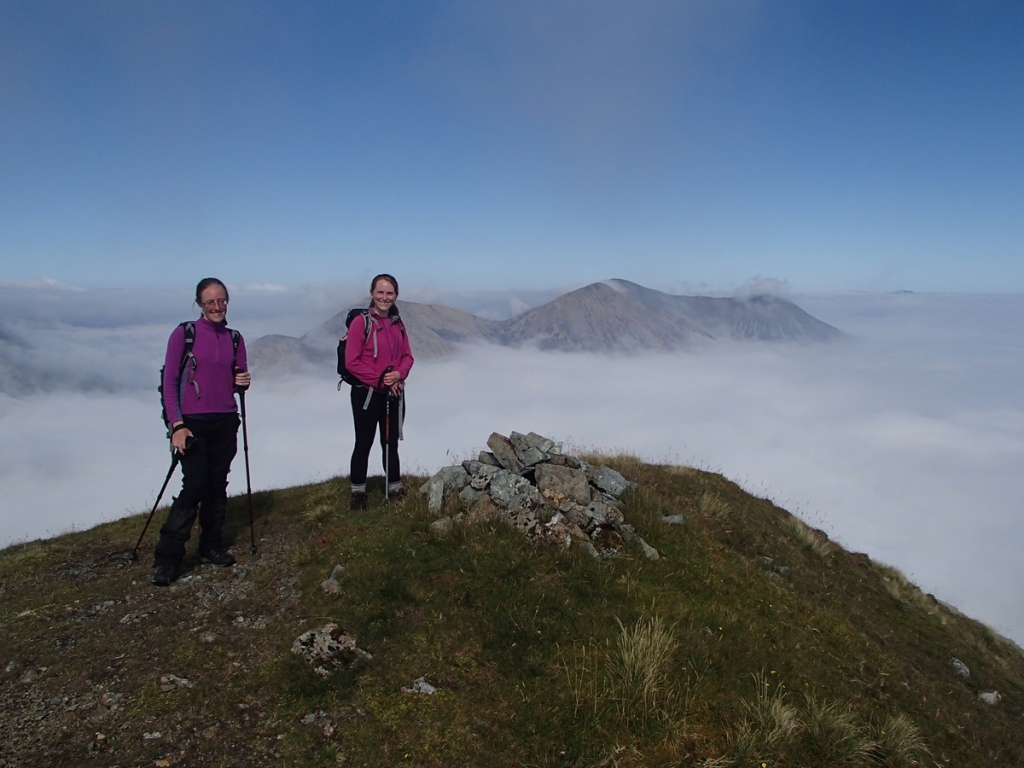
We had arranged to meet up with Amy, a bagging friend who now lives nearby in Drumbuie, for our Saturday walk up Belig (Graham) and Garbh-bheinn (Corbett) on Skye, and she duly arrived in the chosen layby at the appointed time. We had seen as we approached Skye that many of the hills were shrouded in low-level cloud so were hopeful of inversion conditions as we set off up the lower slopes. Sure enough, after about half an hour, we began to emerge from the top of the cloud into the sunshine and for the remainder of our ascent of Belig enjoyed spectactular views over the cloud to Glamaig and the Black Cuillin.
Inversion surrounding Glas Bheinn Mhor and Beinn na CroGarbh-bheinn and the Black CuillinRuth and Amy at the summit of BeligSgurr nan Each and Garbh-bheinn, with Bla Bheinn beyond
A steep descent and re-ascent took us across Bealach na Beiste to Garbh-bheinn, which was in cloud when we arrived but cleared to give great views of Bla Bheinn and the Cuillin as we enjoyed a leisurely lunch. There were more excellent views of Marsco and Glamaig as we descended the easy ridge of Druim Eadar da Choire back to the cars.
Marsco and GlamaigRuth and Amy on the descent from Garbh-bheinn
Having said our goodbyes, Ruth and I headed to Broadford Backpackers Hostel for the night: we had been surprised to find a room available at short notice a couple of days before! Surprisingly but conveniently, even the self-catering kitchen was available for use.
The next morning we headed back west to Sligachan to tackle Skye’s other, better-known Corbett, Glamaig. Once again, half an hour of ascent brought us above the valley cloud, although it was not such a spectacular unbroken layer as the previous day, and the Black Cuillin was fully clear from the start. We mused as we climbed that the Glamaig fell race must not be much fun on the unrelentingly-steep scree and grass, but soon enough reached the summit and paused a while to enjoy the views over Raasay and the rest of the Cuillin hills, as well as some more-distant mainland peaks.
The Black Cuillin, from the steep scree slopes of GlamaigLooking past Beinn Dearg Mhor and Marsco to Garbh-bheinn and Bla BheinnRaasay, with the distinctive peak of Dun Caan
Once we’d taken our fill, we descended equally steep ground to Bealach na Sgairde and then climbed back up to the adjacent Graham, Beinn Dearg Mhor. There the ground became easier for the continuation to Beinn Dearg Mheadhonach, and the day ended with a pleasant, easy descent along the ridge of Druim na Ruaige. A map of our route can be seen here: https://www.plotaroute.com/route/1255818
A great start to our week, with conditions just as spectacular as those we’d enjoyed eight years earlier when we bagged all the Skye Munros! Many more photos can be enjoyed on my album on Google Photos here: https://photos.app.goo.gl/ukDxReoAySqA1A3o7
My parents visited me for a long weekend, the first time I’ve seen them since Christmas! It was really good to catch up with them properly after all this time and to share some of my local hills with them again.
On Friday, a really hot day that reached 35°C at home and around 30°C in the Peak District, we opted to walk on the Roaches, hoping that a high ridge would at least get us up in the breeze! With that in mind, we walked up the valley between the Roaches and Gun in the relative cool of the morning, then returned via Back Forest and the main ridge in the afternoon, enjoying views of Shutlingsloe to the north and towards Gun and The Cloud to the west. A map of our route can be seen here: https://www.plotaroute.com/route/1229779
The Roaches, from the HangingstoneLooking back to Back Forest, with Shutlingsloe in the distance
Saturday was much cooler. With showers expected in the afternoon, we set off fairly early for a walk in the upper part of Dovedale, starting in Alstonefield. We started off by dropping down to Coldeaton Bridge, then headed up Biggin Dale and over the hill to Hartington. Our return route was down Beresford Dale then up onto Narrowdale Hill, a good viewpoint including the reef atolls of Chrome Hill to the north and Thorpe Cloud to the south, and back through the pastures to the car. We didn’t get seriously wet in the couple of short, sharp showers that did arrive after lunch! A map of our route can be seen here: https://www.plotaroute.com/route/1229786
Mum and Dad in Biggin DaleNarrowdale Hill
On Sunday my parents were heading on north to Ruth’s house (Cumbria) after our walk, so we chose something in the Dark Peak as a good way to break their journey. We parked in Hayfield and did an anti-clockwise round of the eastern skyline from there, following the ridge over Mount Famine and the flank of Brown Knoll to Kinder Low, then along the edges to the Downfall and back down via William Clough to the reservoir and village. The air clarity was superb after the previous afternoon’s showers and we enjoyed fantastic views throughout, including west to Chinley Churn and the skyscrapers of Manchester, south over Chapel-en-le-Frith to Black Edge, and east down Edale. A map of our route can be seen here: https://www.plotaroute.com/route/1229792
Kinder Scout, from Mount FamineMum and Dad near Brown KnollLooking down to Kinder Reservoir from Cluther Rocks
I took a couple of days off work for a long weekend break in the Lake District staying in Ruth’s house in Natland, walking solo on the Friday then joined by Ruth (returning from Scotland), Jeff and Helen for the remainder.
Unfortunately for the others, the Friday turned out to be the best weather-day of the trip. I made the most of it with a traverse of all seven Wainwrights in the Coniston Fells, starting somewhat unconventionally in Torver. Sunny spells and excellent air clarity made for excellent views of the adjacent and distant peaks, and the many tarns nestled in the combs below.
Torver Beck, at the Walna Scar Road bridgeLooking north from Coniston Old Man, past Brim Fell to Swirl How and WetherlamBrim Fell and Dow Crag
Returning along the shore of Coniston Water, the campsites seemed much busier than the hills had been. I guess lots of people who would usually holiday abroad have headed to the Lakes this year but not up onto the fells! On my way back to Ruth’s house I took a short second walk up the outlying Marilyn of Kirkby Moor, one that I’ve driven past many times but never paused to bag!
Descending from Kirkby Moor
Saturday dawned a little drizzly so we started it with a 6km run from Natland along the former canal and back along the river. By mid-morning it was drier and brighter so we headed up to Grasmere for an afternoon walk over Helm Crag, Gibson Knott and Calf Crag, then back down Far Easedale. Despite the showery forecast it actually stayed dry and we enjoyed good views throughout. We hoped to pick up some Grasmere gingerbread when we reached the village again but abandoned that plan on seeing the long and slow-moving queue, so returned directly to Natland for tea, nachos, Pimm’s and a hearty chilli and sticky toffee pudding for dinner.
Gibson Knott and Steel Fell, from Helm CragRuth, Helen and Jeff on the ridge to Calf Crag
Sunday had had a better forecast so we opted for a longer walk from the head of Langdale to England’s highest peak, Scafell Pike. It seemed okay as we set off but by the time we were half way up Mickleden rain had set in and didn’t really abate until we were beyond Esk Hause a couple of hours later. With the cloud base holding at around 600m all day we never really got any views either, so it was perhaps surprising that group morale remained high enough to continue all the way to the summit, and to take the more interesting (but not really scenic today!) route back over Esk Pike and Bow Fell. Only on the final descent of The Band did we finally drop back out of the cloud. At least it had remained dry for the second half of the day so we finished with reasonably dry gear and in good spirits. More Pimm’s, beef bourgignon and rhubarb crumble were very welcome in the evening!
After a few hours of rain and mist, we reached the summit of Scafell Pike, England’s highest mountain!At least when we got to Bow Fell, it was not raining any more, and there was only downhill remaining!Great Langdale from The Band
Monday was even wetter, just as forecast this time, so Jeff and Helen headed back home after a leisurely breakfast. Ruth and I popped out in a break in the rain for a late-morning stroll up her nearest hill, The Helm, and I drove back to Hilton after lunch.
It was great to get away from home for a few days with good company and spend time in a familiar but very beautiful part of the country. I now look forward to my next trip, a week in the Highlands in mid-August, which will be my first since New Year, new lockdown restrictions notwithstanding!
It’s been ages since I’ve been to the area around Monsal Dale so I came up with a 30km route starting in Taddington for today’s walk. I set off just after 9am and started by heading east along quiet footpaths towards the bottom of Deepdale, the temperatures already warm in the sunshine! This brought me to the busiest stretch of the walk, up Monsal Dale to Monsal Head then along the Monsal Trail to Cressbrook Mill. Lots of people were out enjoying the fine weather on foot and on bikes.
Blue flowers and blue skies just outside TaddingtonThe weir in Monsal DaleThe classic view from Monsal Head
Once past Cressbrook it was much quieter as I headed up Cressbrook Dale and then across high level pastures and through Tideswell Rake towards Peak Forest. The rake is always interesting to walk up with its extensive mining remains, and today also had lots of yellow and purple flowers to enjoy, as well as great views north to Win Hill and east towards Eyam Edge.
Looking over the pastures to Longstone Moor, from Stanley LodgeColourful purples and yellows in Tideswell Rake
From Peak Forest I dropped into the head of a chain of ever-deeper dales heading south: Dam Dale, Hay Dale, Peter Dale and Monk’s Dale. Hay Dale is the highlight in terms of the scenery. I had forgotten just how rough and awkward the muddy limestone path through Monk’s Dale is! From Miller’s Dale it was just a short climb up to Priestcliffe and back over the A6 to Taddington. Great to be out in the sunshine and to revisit some popular and some little-known places.
Today I fancied a good walk but not really a long drive, so I headed to the closest part of the Peak District, starting my walk at Thorpe. I’ve been avoiding Dovedale during the Covid-19 pandemic as it attracts the crowds, but I hoped a fairly early start would mitigate this and sure enough Thorpe Cloud was deserted at 9am!
Bunster Hill and Dovedale, from the summit of Thorpe Cloud
Having dropped back down to the stepping stones, I continued all the way up the valley to Hartington, passing a scattering of people but never really finding anywhere busy. I enjoyed the limestone outcrops and wild flowers, and the very clear water of the River Dove.
The River DoveLimestone crags and scree further up the dale
From Hartington I made my way west through grassy meadows to Hulme end to pick up the Manifold Trail, which I followed for a mile or so down to Ecton. The hilliest part of the day took me over Ecton Hill and Wetton Hill to Wetton village. Even on these relatively low hills there was a strong wind, so I decided the route had been a good choice for the day!
Looking back to Ecton Hill from Wetton Hill
I followed the rim of the Manifold Valley to Castern Hall. From there it was only a short walk on lanes and footpaths through Ilam and Thorpe back to the car.
The Manifold Valley
Just over twenty miles in total, but fairly flat much of the way so not too strenuous! You can see a map of my route here, and my full photo album on Google Photos here.
The latest update to the policies to help contain Covid-19 in England allows those who, like me, live alone, to join a ‘bubble’ with one other household, and allows bubble members to stay the night in each other’s houses. This opened the opportunity for me to join Ruth’s bubble in Kendal and have access to weekends in the Lake District, a welcome change of scenery with mountains larger than I can reach in a sensible day trip from home.
I drove up from Hilton after dinner on Friday evening, enjoying the still-quiet motorway and lack of major roadworks to arrive in just under 2 and a quarter hours. We discussed various route options for the next day, consulting maps and weather forecasts, and settled on a horseshoe around the upper end of Patterdale.
Arriving and parking up at 9:30am the next morning, we were surprised to find the car park at Brothers Water almost full already! Apparently lots of day-trippers are heading into the Lakes early for walks, with all the accommodation still being closed. We crossed the main road and walked up through Hartsop village – where the car park was also almost full – and climbed steeply up the grassy ridge of Hartsop Dodd: almost deserted. This gave good views down Patterdale to the head of Ullswater, but we entered the cloud as we approached the summit, and remained in the mist as we continued over Caudale Moor.
Looking down Patterdale to Ullswater
We dropped back below the cloud, the base gradually lifting, as we descended onto St Raven’s Edge, and enjoyed the views east towards Ill Bell and south over Windermere. A steep descent brought us to the top of Kirkstone Pass, immediately followed by a steep re-ascent on the well-built path to Red Screes. Here we had the brightest conditions of the day, with patches of sunshine passing over the fells and dales, making for more good views. We continued over Scandale Pass to Little Hart Crag, where we had lunch in the lee of the summit rocks overlooking Dovedale.
Ruth on St Raven’s Edge, with High Street and Ill Bell in the backgroundDovedale and Patterdale
From there our route continued up to Dove Crag, which gave more extensive views west towards Pillar, Great Gable, the Scafells, Langdale and the Coniston Fells. Easy walking brought us to Hart Crag, our high point for the day, where we turned right to descend the long ridge of Hartsop above How, with grand views over Link Cove at the head of Deepdale. A few drops of rain fell as we descended, but not enough to need waterproofs.
Impressive crags in Link Cove
On reaching the valley, a short walk on the permissive path beside the road led us shortly back to Brothers Water. A cloudier day than forecast, but without significant rainfall and mostly below the clouds, so a good day in the mountains all-in-all! A map of the route can be seen here: https://www.plotaroute.com/route/1178017
In the evening, Joe and Andrena rang to ask if they could pause on their cycle ride for a chat in Ruth’s garden, so I had the bonus of catching up with a couple more friends than expected.
On Sunday the weather was forecast to be better in the northwest, so we took a drive up to the Newlands Valley, always one of my favourite areas. It was raining as we parked at Birkrigg, but we set off beside Rigg Beck hopeful of improving conditions with the forecast having predicted sunny spells and showers. Soon we were onto the open fell and could gain the heathery ridge of Ard Crags. There was quite a strong headwind once we reached the higher, flatter part of the ridge, so we were glad that the rain stopped at this point, and that the clouds lifted enough to give some views either side, even if not of the higher summits.
Looking down the Newlands Valley towards Catbells, from Knott Rigg
We continued onto the grassier ground of Knott Rigg then dropped down to the head of Newlands Pass before re-ascending to Buttermere Moss and up the boggy ridge to Robinson. A few sunny spells fleetingly illuminated various parts of the view, including Rannerdale Knotts, and most of the Grasmoor group cleared for a time.
Ruth on Littledale Edge, with views of Gatesgarthdale
We hadn’t been sure whether we’d just descend the north ridge of Robinson, but as we’d arrived in a bright spell, opted to continue along the high ridge to Hindscarth. The next heavy shower arrived just as we were setting off from that summit down towards Scope End, so at least we had the wind behind us this time! It as an easy descent to Low Snab, then over the fields to Gillbrow and back along the lane to Birkrigg.
Scope End
Overall, a wetter day than hoped, but timed pretty well with a prolonged dry spell for our high-level walk between the summits of Ard Crags and Hindscarth. We only saw three other walkers all day: quite a contrast to the previous day on the Eastern Fells which had been bustling with activity! A map of our route can be seen here: https://www.plotaroute.com/route/1178020
We paused on the way back through Kendal for a socially-distanced garden chat with Ian and Emma (and Ellen), where Tom and Becky also happened to drop by at the same time. Good to catch up with everyone over a cup of tea. After an early dinner at Ruth’s, I hit the road back to Derby – another good clear drive. Great to get back into the mountains for a weekend that almost felt normal!
This weekend was one of sunny spells and showers. I got out both days for walks, each around 90 minutes’ drive from home: on Saturday with Ruth in the northwest of the Peak District, and on Sunday with Amina in the Shropshire Hills.
For Saturday, Ruth and I had again selected somewhere to meet that would be a roughly equal length of drive for the two of us, coming from Hilton and Kendal. This time it was Dovestone Reservoir, a place I’d walked through on previous walks from Crowden but never driven to! We met at 10am at the Binn Green car park and soon set off on the tracks around the back of Dovestone Reservoir then up the hydro access road above Chew Brook up to Chew Reservoir.
Looking down Chew Brook towards Stable StonesLooking over Chew Brook from the dam of Chew Reservoir
From there, we followed the slightly boggy path east over the moor to reach the Pennine Way at Laddow Rocks, then followed that better-built trail north beside Crowden Great Brook to the summit of Black Hill, which was just in the mist as we arrived.
Ruth on the Pennine Way from Crowden up to Black Hill
Descending gently to the northwest, the mist soon cleared again. After a kilometre or so we veered left, leaving the path in favour of the rough moorland at the head of Holme Clough. This was very tussocky at first but the going became a bit easier as we got closer to Birchen Clough. A rough descent down to the stream brought us onto a better-than-expected path that led back up to Raven Stones and back around the edges to Dovestone Reservoir.
Greenfield Reservoir, from Raven StonesDescending to Dovestone and Yeoman Hey Reservoirs
It was lovely to catch up with Ruth again for a few hours of socially-distanced walking in one of the less familiar but more dramatic parts of the Peak District. A map of our route can be seen here: https://www.plotaroute.com/route/1165836
I had realised that the Long Mynd was only about as far from Lichfield as the middle of the Peak District is from Hilton, so it would offer a sensible destination for a bit of variety on a walk with Amina. I picked Amina up at around 9:15 and we were parked up in Church Stretton just over an hour later. We set off up the popular Carding Mill Valley where plenty of people had parked, but were pleased to find that not many had ventured more than half a mile from the car park and the higher reaches of the valley were unspoilt by the hustle and bustle.
Heading up the Carding Mill ValleyAmina near the top of Carding Mill Valley
Once up on the main ridge, we continued south to the highest point, Pole Bank, pausing to enjoy watching a pony and her foal for a while. The summit gave hazy views west to Heath Mynd, Corndon Hill and the Stiperstones, but sadly the visibility was too poor to see further into Wales this time. We then dropped down into the head of Ashes Hollow for lunch, before continuing all the down this quiet valley to Little Stretton.
A pony and her foal on the Long MyndAshes Hollow
We had enjoyed bright overcast conditions with the odd sunny spell thus far, but a brief thunderstorm arrived as we reached the village so we paused to put on waterproofs and shelter from the worst of it under a tree. Rain continued, more lightly, as we started the ascent the other side of the valley onto Ragleth Hill, but did pretty-much stop by the time we reached the misty summit. The rain and mist cleared back out again completely as we continued north along the ridge, with views of Caer Caradoc and the Clee Hills, and back across the valley to the Long Mynd.
On the ridge of Ragleth Hill
That just a short descent back into Church Stretton. The drive back took longer than anticipated thanks to sitting stationary on the Shrewsbury Bypass for an hour while the emergency services dealt with an accident. Nonetheless, another good day out in good company. A map of our route can be seen here: https://www.plotaroute.com/route/1167035
This weekend was wetter than any for several months, so I got some chores done at home on the Saturday and only ventured out walking on the Sunday. Jeff and Helen drove up separately and met me at the Cat and Fiddle Inn at 10am for a walk in the Cheshire Peak, nearly three months after our last walk together on The Roaches (just a few miles south) just before the start of lockdown!
The first 45 minutes or so of the walk was in persistent drizzle, over Whetstone Ridge and down into the head of the Dane Valley, but we remained optimistic that the forecast of a drier afternoon would be correct. Sure enough it had pretty much dried up by the time we reached the two pretty stone bridges and waterfall at Three Shire Heads for a short tea break.
Three Shire Heads
We continued around Cut-thorn Hill and over the moor to descend into Wildboarclough, then climbed steeply back up to Shutlingsloe, enjoying views south to The Roaches and north to Shining Tor, and a few sunny spells.
Jeff and Helen on the track around Cut-thorn Hill, with a view of The RoachesShining Tor, from ShutlingsloeLooking towards The Roaches
The busiest section of the walk was along the main stone-flagged path to Macclesfield Forest, where we found a sheltered spot for lunch. We then continued along footpaths and lanes to Lamaload Reservoir, then ascended steeply up Shining Tor from the west, a route I’d only taken once before, and that way back in 2012!
Helen and Jeff below Shining Tor
On reaching the summit of Shining Tor at around quarter to three, we agreed that the direct route back to the Cat & Fiddle would end the day too early, so took a more scenic route, dropping down over Goyt’s Moss then reascending via the lane past Derbyshire Bridge.
It was lovely to spend a full day catching up with Jeff and Helen having only seen them relatively briefly during lockdown. We were lucky with the weather in the end, with no more rain after Three Shire Heads, and the cloud off the tops – although it lingered on Kinder most of the day.
The glorious sunny weather continues so I brought Spring Bank Holiday week to an end (after three days back in the office) with two more walks in the Peak District.
On Saturday it was a solo outing. I decided to head northwest for a walk around the Hayfield skyline, but starting down in Chinley. The route started with an ascent onto Mount Famine to gain the skyline proper, and views towards Kinder Scout. From there I continued up the ridge, over South Head, to Brown Knoll, taking the short detour to visit the trig point at the summit.
Kinder Scout, from Mount FamineSouth Head, from Mount Famine
I dropped down to the top of Jacob’s Ladder, then opted to take the scenic route around Kinder Low End and back up to Red Brook, rather than over Kinder Low itself, a path I’ve only taken once before I think. Having gained the edge of Kinder Scout, I continued past the Downfall and had first lunch near Sandy Heys with great views over Kinder Reservoir and all today’s hills.
Looking down from Kinder Downfall
The stone flagged path west from Mill Hill led me easily down to the main road at Hollinworth Head. From there, I followed quiet footpaths south to Lantern Pike, a great viewpoint for second lunch, before dropping down to Birch Vale and re-ascending to Chinley Churn before dropping back down to Chinley and the car.
Looking over the moors to South Head and Mount Famine (left), Chinley Churn (centre), and Lantern Pike (right)
On Sunday I had arranged to meet up with Heather, Grahame and Ashleigh for a socially-distanced walk from Winster. Okay so it was a day earlier than groups of more than two are technically allowed by the new lockdown rules, but hey who’s checking the small print?! I paused briefly on the drive up to tick off the latest new addition to the list of Derbyshire Tumps: Scarthin Rock above Cromford Mill, which was a good little viewpoint and a worthy place to re-complete this minor hill list!
Cromford Mill, from Scarthin Rock
Once we’d all convened in Winster, we set off north across the valley, down and back up onto Stanton Moor: always a scenic spot and not as busy as I had expected. Having dutifully visited the Cork Stone and Nine Ladies Stone Circle, we followed the lane down through Stanton in Peak, then crossed the fields to Alport.
Looking back over the valley to WinsterGrahame, Heather and Ashleigh on Stanton Moor
We had lunch beside the River Bradford, then followed the Limestone Way up over the pastures to the rocky outcrop of Robin Hood’s Stride. A few boulderers were enjoying the rocks but the summit itself was again pretty quiet. From there it was only a short walk back across the valley and into Winster.
Ashleigh, Heather and Grahame on Robin Hood’s Stride
Another great weekend in my local hills, and great to walk with company again on the Sunday. Hopefully the Covid-19 R value remains low enough that we will continue to be permitted to do this kind of thing, as it makes lockdown so much more bearable!
Thanks to the Covid-19 lockdown, for the first time since 2008 I was not able to spend Spring Bank Holiday week in the Highlands. A sad loss of what is usually my best Scottish week of the year, and particularly frustrating in the present sunny weather, but I was determined to use the Bank Holiday weekend for some good local walks instead.
On Saturday, Amina (from band) joined me for a walk from Baslow, as the east of the Peak District was forecast to have the driest weather. She’s been doing a lot of running during lockdown, and her improved fitness was apparent immediately as we walked briskly up hill onto Baslow Edge. We followed Baslow, Curbar and Froggatt Edges north – one of my favourite walking routes in the Peak – enjoying views over the Derwent Valley and plenty of sunny spells.
Amina at the end of Baslow Edge, with Curbar Edge aheadCurbar Edge. There was a strong westerly wind!
We then dropped down through the woods to Grindleford Station, and re-ascended through the attractive mossy woodlands in Padley Gorge to emerge in the Longshaw Estate. From there our return route was along White Edge, at the top of the moorland ridge, where we felt the full force of the strong westerly wind, making progress harder than it might have been.
Looking towards the Hope Valley from White Edge
Then it was just a short walk along the edge of the forest to Wellington’s Monument and back down the track to Baslow. A lovely day with great company and scenery, and it stayed more-or-less dry throughout.
Sunday was the greyest day of the weekend, so I spent the morning doing a few chores around the house before driving across to Repton for a local walk after lunch. I parked near the Farrows’ house and walked over the fields from Mount Pleasant to Bendall’s Cottages, then up the track and back down through Hartshorne Wood to Hartshorne. There I spent 90 minutes chatting with Jeff and Helen in their garden over freshly baked almond bread and scones!
Undulating farmland near MiltonCow parsley above Repton Common
Suitably refreshed, I headed back over the hill to Repton by the slightly-more-direct route, and spent another hour or so catching up with Dave, Jo and Jess in their back garden before driving back to Hilton. Although I enjoyed all my local explorations walking from home during full lockdown, it was good to be able to omit the flat miles from Hilton to Repton and back today!
Monday was a perfect sunny day, not what one expects on a Bank Holiday at all, so I got a fairly early start to drive up to Ashopton, by the Ladybower Reservoir bridges, where I claimed the last proper marked roadside parking place at just after 9am! Clearly others had formulated similar plans, although the early arrivers had dispersed themselves well and were not really evident at the roadside!
My walk started by climbing up onto Derwent Edge, with great views over Ladybower Reservoir to Win Hill and Kinder Scout. I followed the edge north as far as Back Tor, then turned west to descend via Walker’s Clough to the reservoir track.
Derwent EdgeDerwent Reservoir
From there it was just a short walk through the totally-full Fairholmes car park to escape the crowds again as I ascended through the woods to Lockerbrook Farm. There I picked up the ridge path to Alport Castles, where as usual there were not many others around. I paused for lunch below the crags before continuing down Alport Dale to the road.
Looking up the Woodlands Valley
My third ascent of the day took me gently up to Hope Cross, enjoying views up Edale, and then along the ridge to Win Hill, another busy spot so I didn’t visit the very summit this time, instead bypassing a few metres to the south. That just left a steep descent back to Ladybower dam, by far the busiest place I found. I wove through the crowds, keeping my distance as best I could, to return around the lake shore to the car.
Tuesday is a fixed Rolls-Royce holiday, so I had another day off work to enjoy. I arranged to meet up with Ruth in the South Pennines, roughly half way between our houses. We parked at Ogden Reservoir, near Rochdale, and walked via the Pennine Bridleway and Rochdale Way up on to Blackstone Edge – a new Hump for me to bag!
Ruth near Blackstone EdgeRuth on Blackstone Edge
After lunch near the summit, we followed the Pennine Way south for a couple of miles, back over the M62, and then picked up paths down beside Piethorne Reservoir to the car.
It was great to catch up with Ruth at least for a few hours on a week when we would usually have been Corbett-bagging together in the Highlands. We agreed to meet again in a few weeks for something similar.
With the relaxation of the lockdown rules opening the option of travelling away from home for exercise, I was keen to visit some hillier terrain in the Peak District, and headed up there both days this weekend.
On Saturday, following the best of the weather, I decided to walk in the east, starting in Grindleford. Taking one of my favourite routes, I ascended from Grindleford Station up beside Padley Gorge then up through the Bole Hill quarries and onto Over Owler Tor. There are so many changes of vegetation and scenery in such a short distance here!
Birch woodland on Bole Hill
Then I continued along the moorland ridge to Higger Tor and up on to Stanage Edge. A fair number people were out and about walking and climbing, but there’s so much open space around here that it was not at all difficult to maintain social distancing.
Stanage EdgeLooking down over North Lees towards Eyam Moor and Offerton Moor
I dropped down past Green’s House to Bamford Station, enjoying good views back up to Stanage,then crossed the main road and reascended the other side onto Shatton Moor for lunch, enjoying the views of Edale and the Hope Valley.
Looking from Shatton Moor towards Bamford Edge
From there I dropped down Abney Clough then climbed back up onto Eyam Moor, with excellent views up Bretton Clough with all the spring foliage. Then it was just a short walk back down the lane to Grindleford.
I broke the drive home with a few minutes’ walk from Crich village onto ‘The Tors’, a newly-identified Derbyshire Tump.
On Sunday I fancied a shorter walk, nearer to home, so I put together a 13km loop to tick off another new Derbyshire Tump: Baley Hill, on the rim of Dovedale. Not wanting to include any of the main valley path, lest it be hard to maintain social distancing, I started in Parwich village and followed typical White Peak footpaths through limestone-walled fields to Alsop-en-le-Dale and then around the rim of Dovedale to my objective.
Looking up Dovedale from Baley HillDovedale and Hall Dale
After lunch on the summit, during which only one other group passed by, I headed back over the fields to Tissington and then through Alsop Dale back to Parwich. I had thought I would be re-completing the Derbyshire Tumps today, but it turned out on getting home that another one was found yesterday near Cromford: a target for next weekend!
With more warm, sunny weather on the Friday and Saturday of this Bank Holiday weekend, I did a couple more long-ish walks in the local countryside. While full lockdown continues, I’m making a point of only walking directly from home, but I’m still managing to find new routes and destinations to explore. The first few miles from home in any direction are becoming over-familiar and tedious though! Hopefully the rules will be relaxed soon and we will no longer be discouraged from travelling a few miles to exercise.
Friday’s walk went west and northwest from Hilton. The first few miles were mainly on lanes: through Hilton, briefly across the fields to Marston on Dove, then through Hatton to Scropton. From there I took a series of footpaths that appear to be totally unused, through fairly flat arable farmland to Foston and Harehill. It was nice to walk through the colourful fields of oilseed rape.
Oilseed rape near Grove Plantation
The most scenic section of the walk, with slightly hillier ground, was across the grassy fields up the valley to Cubley and back over the hill to Boylestone. A couple of the fields were occupied by large herds of inquisitive cattle, which was unnerving at times! There was still very little sign of any other walkers having been that way recently.
Looking back towards Cubley from near Boylestone
Heading back to the east from Boylestone I soon reached more familiar trails and lanes that I have explored on my longer training runs. I took the byway past Barton Blount then footpaths over Longford Brook to Sutton-on-the-Hill, then followed the Willowpit Lane – a surprisingly popular walking route at the moment apparently – back to Hilton.
Saturday was even warmer and sunnier than Friday had been! I took my fourth fortnightly social walk to Hartshorne and Burton. Bored of the route through Egginton and up the canal to Willington, I decided to try just walking along the main road for a change. All but 1.5km of it has a pavement, and it wasn’t busy first thing in the morning. I did at least get a closer view of the strange swampy copse near the Egginton-Etwall crossroads!
The swamp on Egginton Common!
I continued along the road to Repton, and was then pleased to get onto bridleways and footpaths for a few miles, crossing the ridge to Milton then heading towards Ticknall but dropping down to Bendalls Farm to pick up the paths beside Foremark Reservoir. Officially the site has been closed by Severn Trent Water but, with the whole place near deserted, there seemed little reason not to follow the undulating lakeside permissive path down towards Carver’s Rocks. There I picked up public footpaths up through the woods and back down to Hartshorne.
Foremark Reservoir
It was lovely to chat to Jeff and Helen for an hour and a half as I sat eating my lunch in their back garden – at a distance of course – and to help them dispose of a couple more glasses of surplus prosecco from their postponed wedding!
I then continued through Caulkley Wood, with some bluebells but now past their best, and up Moxon’s Hill to Bretby Hall, then went up the long driveway to pick up the main road into Burton, where I stopped for another 90 minutes to chat to Heather over tea and cake on their patio. It was great to catch up face-to-face.
Heading from Caulkley Wood towards Moxon’s HillLooking up the Bretby valley
Rather than my usual route up the canal and through Eggington, I decided to mix up the walk home by picking up the Jinnie Nature Trail – a disused railway – from Stretton to Rolleston, and then followed the lanes back to Hilton via Marston. After a long day out, I was pleased to find that the fish and chip shop has re-opened, giving me a good option for a quick, lazy and filling dinner!
Once again I spent my Saturday doing a long (43km) walk from home to explore some more of the local countryside. After a wetter week, it was fortunate that the day was once again warm and dry, and I found that the ground has not yet had time to become muddy again. I hoped that some of the small woodlands in Needwood Forest, an area I’ve never visited, might offer good displays of bluebells, and was not disappointed!
I started on familiar ground, of course, joining the Trent & Mersey Canal near Egginton and heading south along the towpath, further than I’ve been before, to Shobnall at the far side of Burton. There I found hillier ground on the wooded ridge of Sinai Wood, before dropping back down to Tatenhill.
A quiet morning on the towpath of the Trent & Mersey Canal
My route then continued west, following attractive but little-walked footpaths over Tatenhill Common, then from Rangemoor towards Yoxall Lodge. Several of the small pockets of woodland had a good carpet of bluebells, particularly one called The Dingle.
Bluebells in The DingleMore bluebells
On reaching Brakenhurst Wood, my route turned north, initially through the forest then over fields to the attractive village of Newborough.
Brakenhurst Wood
The homeward leg crossed undulating farmland to Hanbury Grange, Woodend, and eventually Tutbury, where I rejoined the familiar local paths to Marston on Dove and home.
The fantastic April weather continued, so I went for another long walk from home to make the most of it while complying with the social distancing rules. This time I picked a route that would pass through a few wooded areas, in hope of seeing some good displays of bluebells.
The first few miles were on my now-regular route via Derby Airfield to Egginton, across the A38 to the canal, and up the towpath to Willington. I wish there were more bridges over the River Trent – one at Newton Solney would be really useful! Once across the river, I followed the road to Repton, then took some unfamiliar footpaths back towards the river and Twyford. A small chain ferry operated here until 1963.
Looking over the Trent to Twyford
Then I headed back away from the river to pass Foremarke Hall and continue up to Heath Wood, where I found by far the best bluebells of the day.
Heath Wood had the best displays of bluebells of the dayThe path through Heath Wood
I continued through the fringes of Robin Wood and across the fields to Ticknall, then through Calke Park and up onto the ridge of Pistern Hill. From there it was only a short distance down through Several Wood and over the fields to Hartshorne, where I chatted to Jeff and Helen in their garden for an hour or so over lunch and prosecco on what should have been their wedding day (sadly postponed, but at least it gives me some extra time to write my Best Man’s speech!).
Pisternhill Plantation
I continued up to Midway then took the footpath through Burton Golf Course (not open for golf currently, of course) to reach Heather’s house mid-afternoon. I chatted to her and Grahame in their garden over tea and cake, then continued home by my normal route along the canal and through Egginton.
The canal is so still with very little boat traffic at the moment!
A long day out in the sunshine, covering 46km in total! Lovely to see a few friends at a safe distance.
I spent another sunny Sunday morning exploring more unfamiliar local footpaths, stringing together a few of the local churches. Heading north to start with, I followed the roads to Etwall then deserted paths via Dalbury to Trusley. From there I looped back around to the west, via Sutton on the Hill to Hoon Ridge and Marston on Dove. Finally I followed the little-used footpath around the bottom of Hilton, across the Dove floodplain to Egginton, to join the road home at Derby Airfield.
Fresh foliage near TrusleyClimbing to Sutton on the HillThe River Dove near Hilton
The pandemic sadly put paid to my Corbett-bagging plans for Easter weekend in the Cairngorms and Monadhliath, so I had to content myself with further local explorations in the sunshine! The local paths range from deserted to quiet (a bit like most Corbetts!), so social distancing has been pretty easy even when covering some significant distances (about 120km over the four days!). I’ve also perfected the art of opening gates with my elbow and crossing stiles without using my hands!
On a very sunny Good Friday, I explored southwest from Hilton, heading along the lane to Rolleston then along footpaths through farmland to Hanbury, then dropped down to Fauld and returned along the valley to Hatton and then home.
The steep-sided combe below HanburyThe River Dove, near Tutbury
Saturday was even hotter for a long walk (42km!) to the east and southeast. I followed footpaths through the woodland around the back of the Toyota factory to get to Findern, then joined the Trent & Mersey Canal as far as Swarkestone. From there the ground became a bit hillier as I continued through Robin Wood to Ticknall and on to Hartshorne, for Bakewell tarts and a socially-distant chat on Jeff & Helen’s driveway. I continued over the hill to Repton, for a short chat with the Farrows over the garden gate, then back to Hilton via Willington, the canal, and Egginton.
The Trent & Mersey Canal, near SwarkestoneDescending across Repton Common
On Sunday I turned my attention to the northeast, following the disused railway to Mickleover and continuing a few miles further to reach Markeaton Park for a short walk-and-talk around the parkrun course with (but safely distant from) Ashleigh. I headed back through Mackworth and Mickleover to rejoin the return leg of my standard 10-mile running route via Burnaston and Etwall.
Heading up the Great Northern Greenway
Easter Monday was cloudier with a cold wind. I started by walking to Rolleston again, then followed footpaths via Upper Outwoods to Shobnall. From there it was a short walk across town for a slice of treacle tart outside Heather’s kitchen window (and a chat). I took the direct route back, up the canal to Egginton then past Derby Airfield.
Blossom-laden trees in Egginton
With the exceptional Bank Holiday weather, it’s been great to get out in the fresh air each day and to explore a few new places around home. Many of the paths will also be good new options for running!